ACC Rio Grande Featured in Retrofit Magazine
Retrofit Team
Architect, Interior Design: Studio8 Architects, studio8architects.com
Design Architect: Overland Partners, www.overlandpartners.com
Collaborators: Architexas, architexas.com and Hutson Gallagher, hutsongallagher.com
The Retrofit
Nestled in Austin’s urban core, ACC’s historic Rio Grande Campus represents an educational legacy, having served the community for more than a century. The overarching challenge was to transform the building into a state-of-the-art learning hub that enhances occupant wellbeing and comfort through sustainable building practices while
preserving its historical integrity.
The building, constructed in two phases in 1916 and 1926, revealed unexpected differences in materials. The 1916 structure features durable double-wythe mass masonry walls while the 1926 addition used hollow clay tile with a brick veneer, likely a cost-saving measure. Removing windows exposed open clay tile cores at the jambs, complicating the anchorage for new windows. To address this, a forensic engineer recommended replacing sections of clay tile at the jambs with reinforced CMU while preserving the exterior brick veneer, ensuring structurally sound supports for the new windows.
Exploratory demolition uncovered further surprises. Original 1916 drawings suggested load-bearing masonry walls and wood framing, but the building had a concrete frame with “leave-in-place” metal pan joist forming. This discovery allowed for the removal of all interior walls, enabling a new, efficient floor plan to support the updated educational program.
Amid the construction process, remnants of the building’s history emerged: old chalkboards with lessons still written; a forgotten student mural; and artifacts, like ornamental railing sections and auditorium seats. Although not all items could be salvaged, the design incorporates a history niche, displaying these elements alongside
historic photos and the original school clock.
The building’s south side was excavated to the basement level to provide enhanced handicap accessibility and create a substantial sunken court with terraced seating for programmed events and student gatherings.

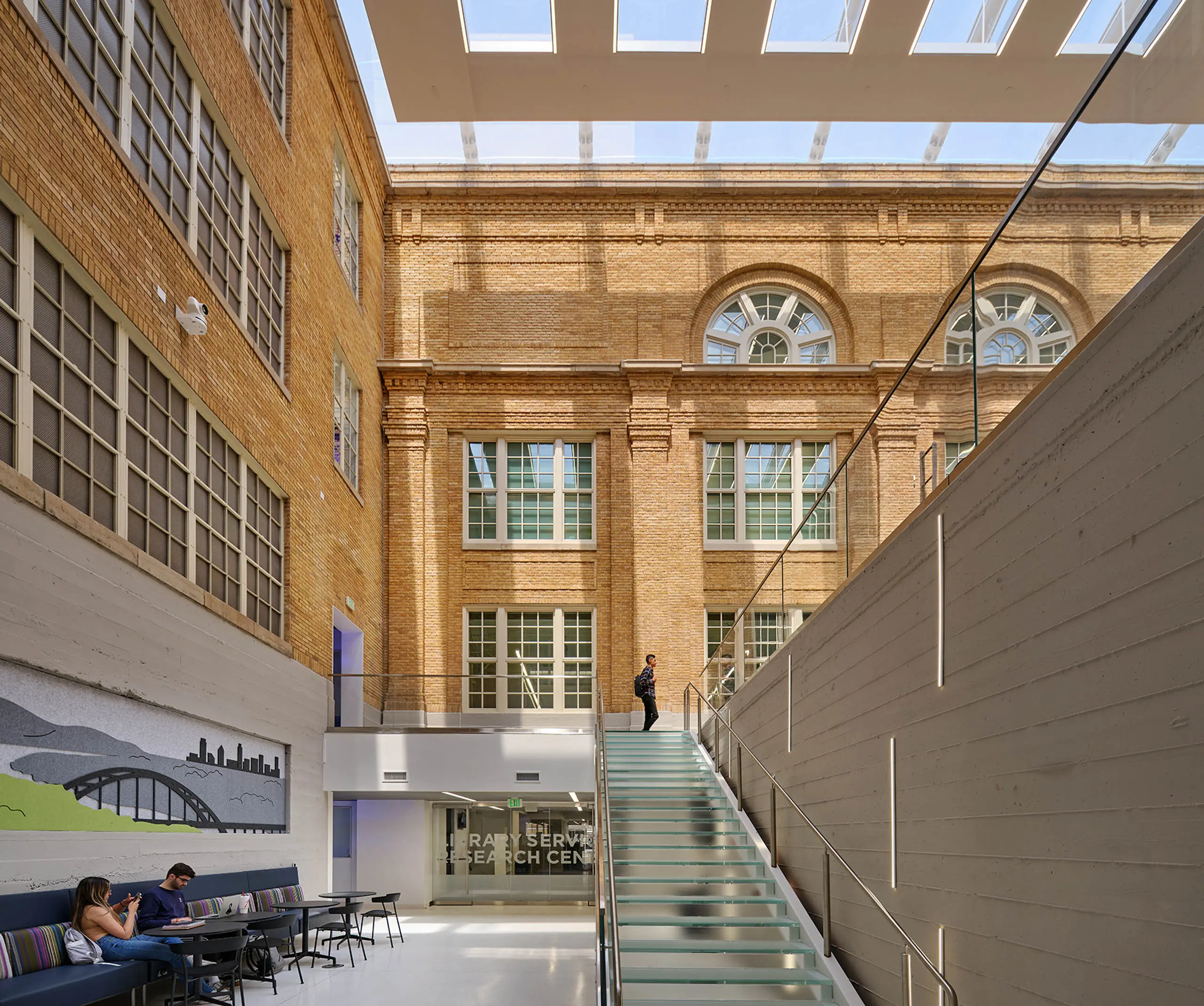
Two existing exterior courtyards were enclosed to create sheltered light courts; one is used as a commons area for studying and relaxing, and the other is a flexible space that can be configured for group gatherings. The architects selected a lightweight ethylene tetrafluoroethylene, or ETFE, roof that provides shelter from the elements, controls daylight and spans the opening without the need for any major structures.
The renovation transformed an unused auditorium into the Army Futures Command’s Software Factory. Building on the college’s computer science and IT programs, the facility offers specialized training in emerging technologies, like data science and AI.
The centerpiece of the campus is a vertically oriented, three-level, 168-seat ACCelerator learning lab that is integrated with the campus library. The building’s perimeter includes six science labs for physics and geology, general biology and anatomy, general and organic chemistry, as well as classrooms, offices, student services and student life. Classroom furniture supports active learning with mobile tables and chairs that adapt to group activities, interactive sessions and traditional lectures.
New materials incorporate reused, recycled and regional content, and the project reduced construction and demolition waste by at least 75 percent. A central utility plant serves the building and provides 30 percent HVAC efficiency over baseline. Tapping into the City of Austin’s recycled water line will save some 200,000 gallons of water per year. In addition, the new landscaping uses no potable water for irrigation.
Original article can be found here.